A bit of background, I graduated from Mississippi State with a M.S. Geoscience, and briefly worked for the Environmental Protection Agency. This background information is given solely to lay the predicate to the analysis below.
The idea that carbon dioxide is the cause of global warming has it's support in the “greenhouse effect.” Mechanically the greenhouse effect works as follows: greenhouse gasses trap heat in the troposphere and prevent it from radiating out to space. Energy from the sun is shortwave radiation. This shortwave radiation is absorbed by the surface of the Earth (or objects thereupon) and transformed into longwave radiation. The longwave radiation is in turn radiated out to space. The greenhouse gasses absorb longwave radiation on the way back to space and reradiate the energy back down to the surface which then transforms it back into long wave radiation which warms the atmosphere from the bottom up. If you measure temperature with height you see temperature drop with height. The greenhouse effect theory states that the air temperature will increase until the greenhouse gasses layer and then temperatures will decrease above the greenhouse layer. In more simple terms the troposphere will warm and the stratosphere will cool under the greenhouse theory.
In order for Carbon Dioxide to be causing global warming as explained by the greenhouse effect, four elements must be met:
1) The surface temperature must be above normal
2) The surface temperature must be continuing to warm
3) Stratospheric temperature must be below normal
4) Stratospheric temperature must be continuing to cool
I. The surface temperature must be above normal
This is an area that is not in serious dispute. Although over long periods the surface temperature has been both higher and lower, in general surface temperatures are higher than they were 50 and 100 years ago. Using the 1961-1990 mean temperature as “normal”, the mean global temperature became above normal in 1977 and has been above normal for all but three years since then. (source: http://cdiac.esd.ornl.gov/trends/temp/jonescru/jones.html)
II. The surface temperature must be continuing to warm
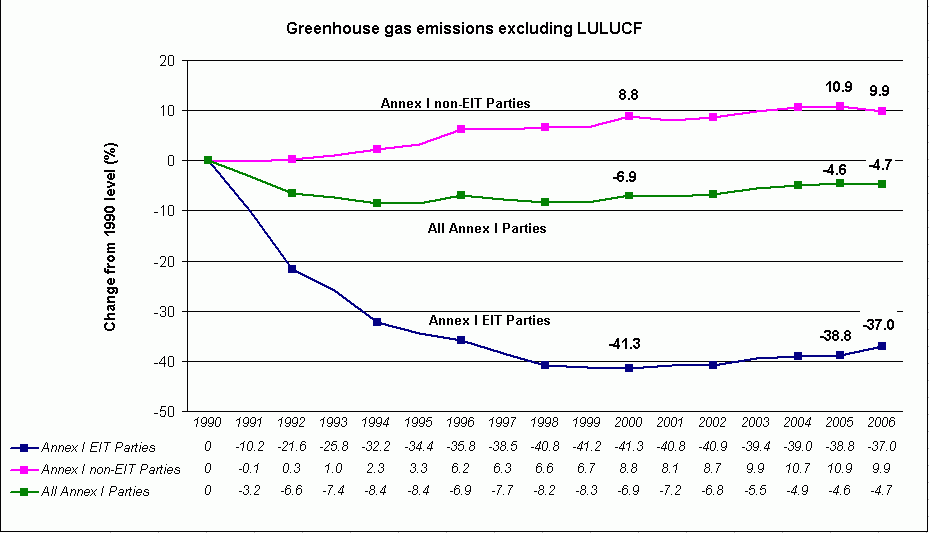
If the greenhouse effect is to blame for the current global warming, then the temperature at the surface should continue to rise as greenhouse gasses in the atmosphere continue to accumulate. Although greenhouse gas emissions have declined since 1990, they have been increasing since approximately 1999. (Sources: http://www.sciam.com/article.cfm?id=from-bad-to-worse-with-greenhouse-gas-emissions , http://unfccc.int/files/inc/graphics/image/gif/trends_excluding_2008.gif )What we see is global temperature reached its maximum anomaly in 1998, and has been unsteadily dropping since then. (source: http://cdiac.esd.ornl.gov/trends/temp/jonescru/jones.html)
If the greenhouse effect theory was the source of the global temperature change, there would have been temperature decreases in the late 1990s when the emissions dropped and they would be rising now as emissions are increasing. In the alternative, if the change in global temperature was caused by accumulated greenhouse gases in the atmosphere, then we would continue to see temperature increasing as increased greenhouse gas emissions cause a continuing rise in greenhouse gas accumulations in the atmosphere. Under either scenario, we would not be seeing a temperature drop that we are now seeing.
IIII and IV Stratospheric Temperature Must be Below Normal and Continuing to Cool
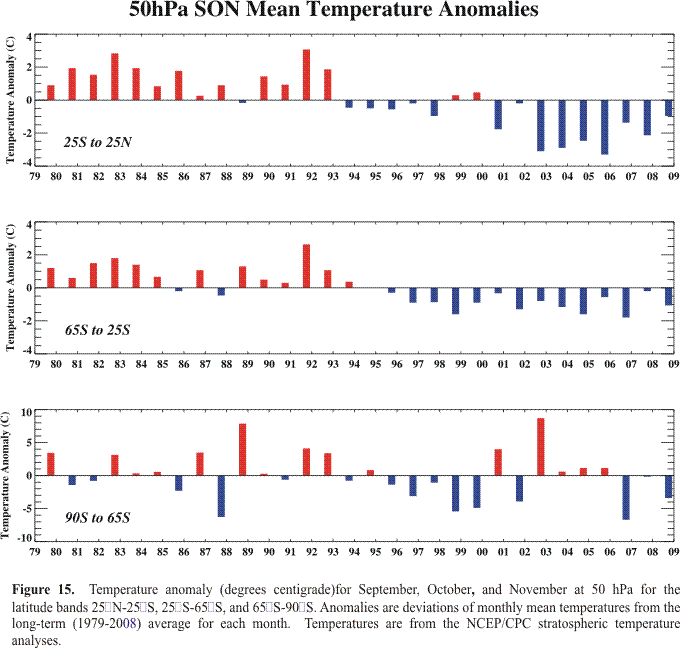
If the greenhouse effect theory is correct, the greenhouse gases that are warming the surface are causing the stratosphere to cool. The atmosphere is heated from below via longwave radiation. The greenhouse gasses in theory absorb longwave radiation and reradiate it out in all directions. This reduces the amount of longwave radiation reaching the stratosphere, and the stratosphere cools. In general, this is not happening (source: http://www.cpc.ncep.noaa.gov/products/stratosphere/winter_bulletins/sh_08/Fig_15.gif )
A good way to determine if the stratosphere is warming or cooling is to look at the amount of ozone destruction occurring. Ozone is an unstable form of oxygen. Breathable oxygen is diatomic, while ozone is triatomic. Triatomic oxygen is unstable and readily breaks down. Ozone forms when ultraviolet radiation is absorbed by oxygen. Ozone is formed in the tropics, above the rainforests, and gradually rises and spreads pole ward via Brewer-Dobson circulation. At its most basic level this circulation is isentropic upglide and isentropic downglide.
In general, an isentrope is a line of equal entropy, in meteorology an isentrope is a line of equal equivalent potential temperature. Although isentropes are found at altitude, if you were to mathematically follow one to its end it would eventually run into the ground. As a result isentropic movement can be upward or downward depending on the direction of the prevailing wind. So ozone forms above the rainforests and then is pushed upward and pole ward by the prevailing winds in the Brewer-Dobson circulation. The circulation works well to transport ozone until winter comes. In the winter the polar jet increases speed and seals off the polar air form the rest of the atmosphere. This means that new ozone cannot replace any ozone destroyed.
Ozone is destroyed when another chemical comes in and bonds with the oxygen. The reaction surface for this chemical reaction is a Polar Stratospheric Cloud (PSC.) These clouds don't look like a cloud like we are used to seeing. These clouds are colorful because they are not made out of liquid water.
Sometimes clouds are made out of ice crystals, for example a cirrus cloud, and will give different coloration such as a cirrus cloud crystals making a fire rainbow. Other times the clouds are made out of liquids that are not water. When the temperature drops to -78 degrees gasses in the atmosphere can condense and become liquid. These liquids then become clouds just like water vapor condensing into liquid water to form a cloud like we see. These liquid droplets then refract the sun’s rays leading to coloration like a water droplet does to lead to white clouds.
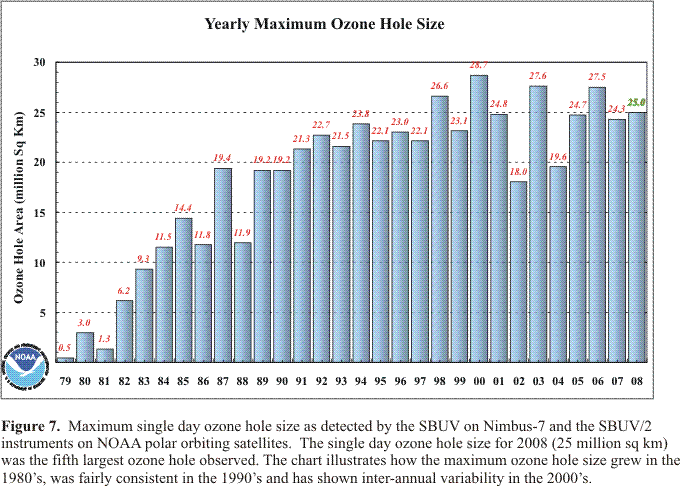
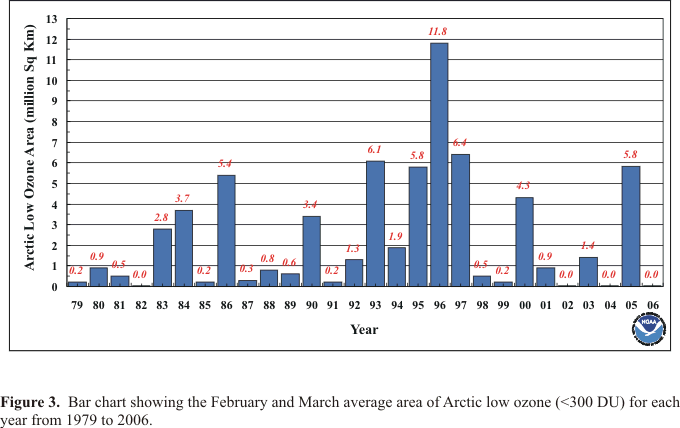
Because of the long atmospheric life of ozone destroying chemicals (ODCs) in the air the amount of ozone destruction is controlled by the amount of PSCs that form rather than the amount of ODCs in the air. The amount of PSCs that form is controlled by the amount of time the temperature is at or below -78 degrees. In short stratospheric temperature is what controls ozone destruction. The colder it gets, and the longer it stays cold, the more ozone destruction will occur. Once the polar jet slows in the spring the Brewer-Dobson circulation brings in fresh ozone and ozone levels return to normal. As a result we get finite amounts of ozone destruction every year. Rather than seeing ever increasing amounts of ozone destruction, the amount of ozone destruction is declining. (Sources: http://www.cpc.ncep.noaa.gov/products/stratosphere/winter_bulletins/sh_08/Fig_7.gif , http://www.cpc.ncep.noaa.gov/products/stratosphere/winter_bulletins/nh_05-06/figure_03.gif )
In short, because of the disconnect between surface temperatures and ozone destruction and greenhouse gas accumulations it seems that the greenhouse effect theory is not the mechanism that is causing global warming. Something is causing the warming, but to focus our time and resources on carbon dioxide reduction only lets the problem progress without heading towards solution.